
Batteries Lower Bills! Council Members, Utility Customers and Affordability Advocates Demand that Con Ed Allow Battery Storage in NYC to Reduce Energy Bills
May 29, 2026
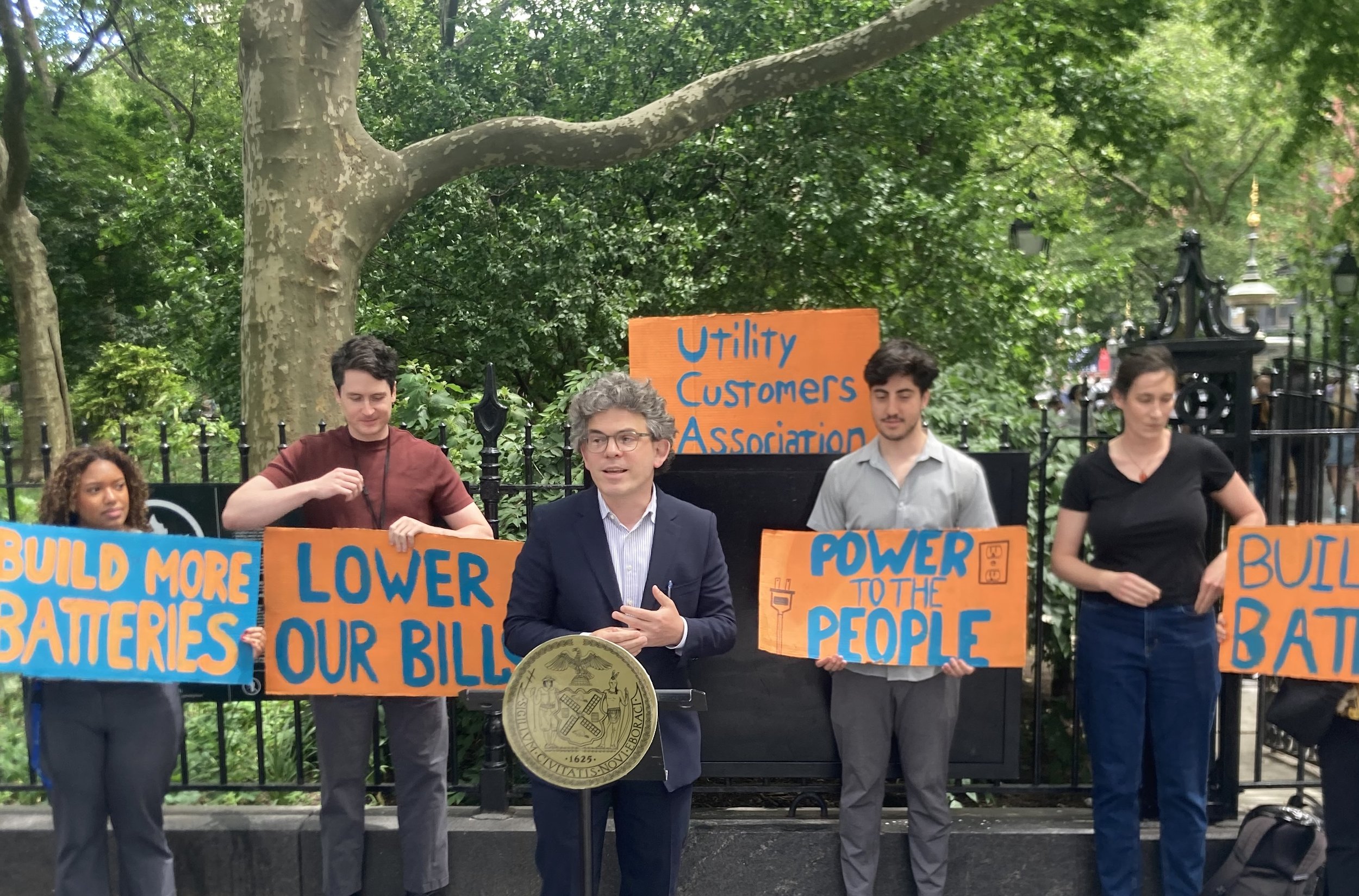
New York City - City Council Members, utility customers and affordability advocates gathered today outside City Hall to demand that electric utility Con Edison help reduce electric bills by allowing more battery storage in New York City. For the last nine months, Con Ed has been standing in the way of battery development in New York City, prompting a growing movement among utility customers and New York City residents to demand the utility reverse course. As part of this pro-battery movement, utility customers endorsed City Council Resolution 422, introduced by City Councilmember Sandy Nurse, which demands that the Public Service Commission step in and protect battery development.
For more information about Con Edison’s de facto battery moratorium and the growing community movement to win battery storage, see recent coverage in New York Focus and QNS.com. Further background is also available below.
“We are about to go through the hottest summer on record with a weakened, unreliable energy grid – and we aren’t prepared,” said Council Member Sandy Nurse. “Battery energy storage systems play a crucial role in making our grid more resilient by preventing blackouts, lowering our energy bills, and keeping people alive during increasingly hotter and longer summers. With Con Ed effectively blocking new battery projects, the Council needs to pass my bills, Intro 359 and Reso 422, to fight back against Con Ed’s rapacious corporate greed and pave the way for a just transition to a more sustainable future.”
“At a time when our communities are struggling with rising electric bills, expanding battery storage will lower utility costs and reduce dependence on fossil fuels,” said Council Member Lincoln Restler, “but Con Ed is prioritizing their profits over our renewable energy future. I encourage the Public Service Commission to direct Con Ed to increase utilization of grid connected batteries immediately.”
“ConEd is using spurious claims to justify raising interconnection costs more than 30 fold without ever getting permission nor oversight from the PSC,” said Council Member James Gennaro. “They claim that an increase in battery storage citywide would strain existing capacity. The truth is the exact opposite: battery storage reduces the need for peaker plants and new substations, which lowers costs overall. ConEd owes it to ratepayers to stop raising interconnection costs.”
“Environmental Justice communities face higher rates of energy insecurity—yet another vulnerability faced by Black and brown New Yorkers during extreme weather events. Battery Energy Storage Systems empower our communities with more access to reliable and more affordable energy. As a representative of an Environmental Justice community, I am proud to support Res 422 in support of building out these BESS systems to support our neighbors and doing so with an eye towards building healthy and sustainable communities,” said Council Member Alexa Avilés.
"This is profit seeking by a big private company, pure and simple," said Councilmember Shahana Hanif. "Con Edison is putting up roadblocks to new battery storage because they make more money this way. My constituents - and all New Yorkers - deserve better. That's why I have called for public power, and why I am proud to support Resolution 422. We need a reliable grid, at prices we can afford, and batteries will help us get there."
“Batteries lower bills. The more batteries we build, the less we need to pay the utilities for costly upgrades that drive up costs for consumers,” said Patrick Robbins, Director of the Utility Customers Association. “Con Edison must stop standing in the way.”
"For too long, energy affordability and the clean energy transition have been framed as two conflicting ideals for our electric grid. We see again today that Con Edison is perpetuating this false narrative while their executives make tens of millions a year. New Yorkers are tired of paying high electric bills and the public health costs caused by peaker power plants. The Public Service Commission must act immediately on its mandate to ensure access to safe, reliable utility service and lift Con Ed's de facto moratorium on distributed battery energy storage systems," says Daniel Chu, Senior Energy Planner at New York City Environmental Justice Alliance.
“Right now, when electricity demand is high, ConEdison wastes our money to buy power from the oldest and dirtiest power plants in the state, which are also the most expensive power plants to operate,” said Delia Kulukundis from 350Brooklyn. “Now that we have the technology - battery energy storage systems - to replace peaker plants, we could have cleaner air and lower energy bills in New York City, but ConEd is standing in the way. We support Councilmember Nurse’s resolution and we call upon the Public Service Commission to rein in ConEd’s behavior.”
“Our low income cooperatives face disproportionally high energy burdens, and we need to take concrete steps to solve this deep seated issue,” said Danilo Jimenez, Climate and Resiliency Project Associate for the Urban Homesteading Assistance Board (UHAB). “Increasing our state’s battery storage capacity represents a tangible effort to lower our residents' energy bills and helps address the wider issue of building decarbonization.”
"As we enter what will likely be the hottest summer on record, Con Edison continues to block key measures needed to protect our energy grid and the most vulnerable New Yorkers. Our 3,000+ high school and college members stand strongly in favor of Intro 359 and urge the City Council to take action immediately," said Shiv Soin, Co-Executive Director, TREEage
Further Background:
Last summer, Con Edison changed how it charges battery developers to connect to the electric grid. According to numerous battery developers, interconnection costs rose by thirty or forty times what is typical, effectively blocking new battery construction in New York City. Utility customers, lawmakers, and community advocates have been pushing back, and are calling on the Public Service Commission to protect battery storage and lower bills for New Yorkers.
Batteries can store energy during times when electricity is cheap, and sell back to the grid at times when electricity is expensive, which brings electricity costs down for ratepayers. They also lower bills by making New York less reliant on dirty and expensive peak power plants to provide energy during peak moments like hot summer afternoons. Con Edison has claimed that if all battery projects that have been proposed actually get built, and they all charge at the same time, then it could create strain on the grid. In reality, however, only a fraction of projects that get proposed ever make it to completion, and Con Edison’s analysis does not take into account any planned capacity expansions from the company. Additionally, Con Edison’s argument fails to plan for a scenario in which the utility could place limits on when battery developers can draw from the electric grid to charge the batteries, which would obviate the need for Con Ed to build new infrastructure to support charging.
####